About
Claude Code is powerful. Open Code is private. Second Brain is both.
Powered by Python, WhisperX, ChromaDB, Tesseract, and FFmpeg. Everything runs locally except when you choose to use Claude.






How to Setup
Install OpenCode with a local model
Go to opencode.ai and connect it to a local model that runs on your device. Do not use a cloud provider.
Configure Your Vault
Copy this into OpenCode to set up your Second Brain:
How to Use
Capture
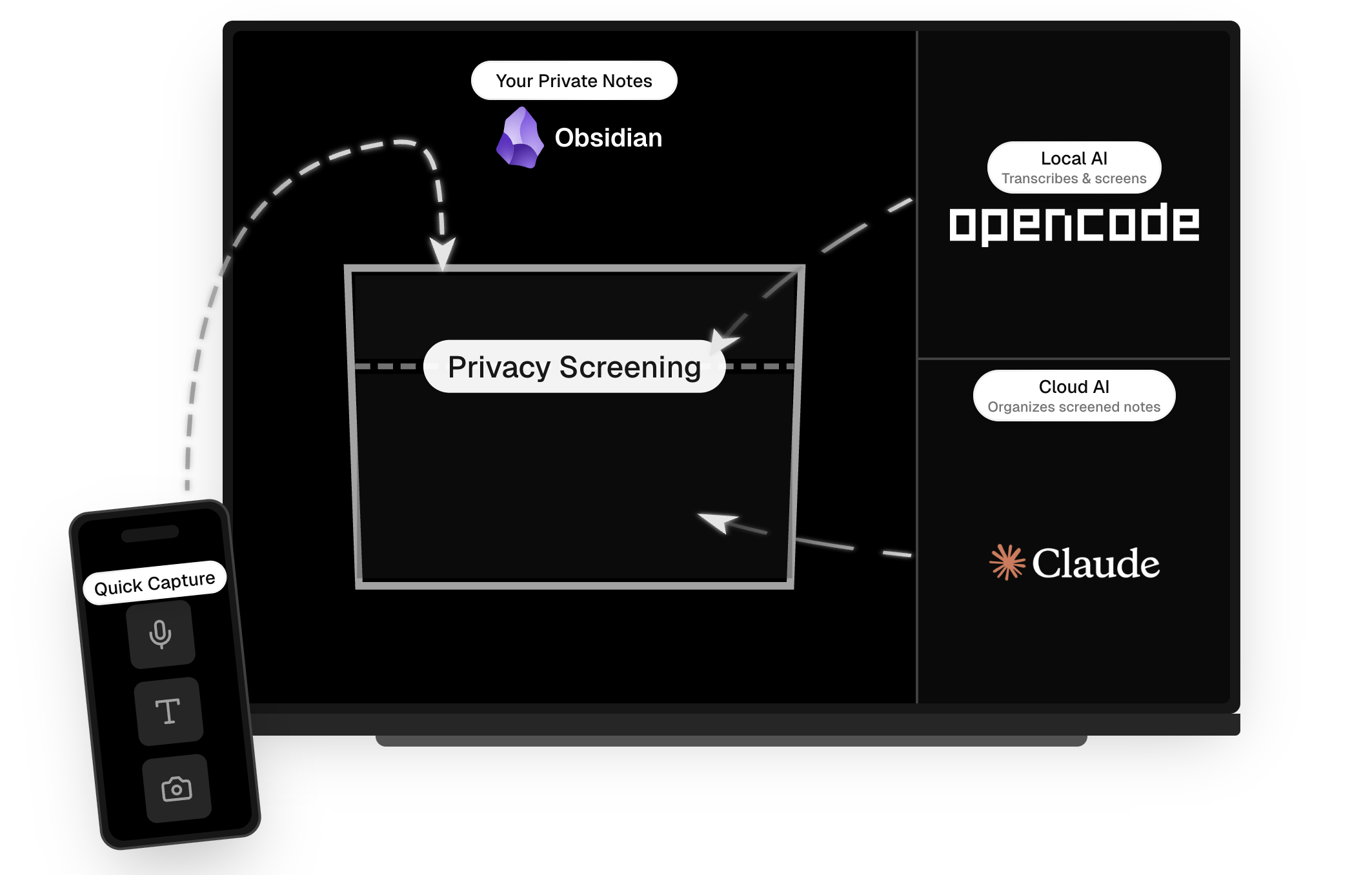
Record voice, snap photos, or type notes on your phone. Sync to your Obsidian vault.
Process Locally
Tell OpenCode:
Converts audio/images to text
Flags private content
Moves files to cloud or private folders
Organize with Cloud
Tell Claude:
Sorts notes into folders, indexes for search
Or just ask questions about your notes.
Questions?
Everything you need to know
Do I need to be technical?
No. If you can copy-paste a command into OpenCode, you can use Second Brain. The AI handles installation, configuration, and all the technical complexity for you.
What does this cost?
OpenCode and Obsidian are free. Obsidian Sync (for phone-to-laptop sync) is $4/month. Local AI models are free. Cloud models like Claude cost a few dollars per month for typical use.
Is my data private?
Yes. All transcription and privacy screening happens locally on your device via OpenCode. Only content you explicitly approve gets sent to Claude for organization. Obsidian Sync is end-to-end encrypted. This is open source and privacy-first by design.
What's the difference between OpenCode and Claude?
OpenCode runs a local AI on your machine for private tasks like transcription and privacy screening. Claude is a cloud AI used only for organizing notes you've already screened. Nothing leaves your computer without your approval.
Where does my data live?
On your computer, in a folder you control. Your entire Second Brain is just markdown files you own. If you use Obsidian Sync, your data is end-to-end encrypted—even Obsidian can't read it.
Can I use different tools?
Absolutely. Prefer Cursor over OpenCode? Go for it. VS Code over Obsidian? Live your best life. Cline, Windsurf, Claude Code? The system works with any markdown editor and any AI coding assistant. Your brain, your tools, your rules.